Do you feel like everything is crashing down on you and you can’t keep up? Sometimes the weight we carry isn’t just about the physical clutter around us—it is about the volume of information we let in. In this post, I want to share my own story along with the tangible digital minimalism practices I have lived by for several years now. We will unpack concepts like FOMO versus JOMO, explore solitude deprivation, and look at the vicious cycle of endless scrolling.
Are You Feeling Overwhelmed?
Does it feel like everything is closing in on you? Do you frequently catch yourself saying, “My head is spinning” or “I simply can’t keep up”? There are simply too many demands, too many tasks, and above all, that relentless, anxious feeling that you are constantly running behind.
What if the primary cause isn’t merely the state of your living space or your belongings, but the relentless stream of information you expose yourself to? That is precisely why I want to focus on digital minimalism today. This topic is deeply personal to me, so I will weave practical guidance together with my lived experience.
Our Smartphones Are Glued to Our Hands
To me, the greatest danger lies in the constant proximity of our smartphones. We carry them in our bags, in our purses, in our pockets. It is our era’s subtle addiction. Notice the uneasy panic that sets in whenever you misplace your phone or realize you left it behind.
We pick it up countless times a day just to see what is new. Everyone’s habit looks slightly different, but at its root, it is a compulsion to smother every open moment that might arise. Whether commuting, standing in line, or feeling a flicker of boredom, we reach for the device because it promises novelty—an experience, quick entertainment, a hit of new information.
Roughly sixty thousand photos and videos are uploaded to Instagram every single minute. Interestingly, when looking for exact numbers, Meta—the parent company behind Facebook and Instagram—rarely discloses up-to-date platform metrics. We don’t know the exact figure today; it may well be even higher, as that reference comes from an older milestone rather than recent platform disclosures.
My Story with Instagram
Looking back about eight years, that was the chapter when Instagram entered my world. A hyper-filtered, rose-tinted landscape saturated with dreams, aspirations, and self-promotion. A digital arena where countless people believe they will discover fulfillment, launch their ideas, and finally be seen. It is a siren song that captures people all over the world.
On one side stand creators; on the other, consumers. Today, my focus is primarily on offering grounding practices for those consuming content, though I will touch on the creator perspective as well. It is impossible for me to separate the two entirely, because I never used Instagram solely as a passive viewer. I was always creating.
Instagram remains a sensitive chapter for me. It has been about four years since I made the firm decision to stop posting there entirely. It was not an easy leap; as an author and founder, you naturally want people to find your work. But I reached a breaking point where my well-being was completely compromised. And it is no exaggeration to say that Instagram nearly dismantled my life.
It all began with pure euphoria. Early in building my project, I was persuaded that Instagram was the ultimate platform to share my voice and connect with the world. In retrospect, I had to confront an honest truth: what nourishes me most is reading books, listening to audiobooks, the occasional podcast, and above all, writing and deep creative thought. As a creator, I should never have chosen a fast-paced platform built on fleeting, short-form snippets.
Yet I kept pushing deeper into the algorithm. Following every marketing rule, I published posts twice a week and faithfully shared at least one story every single day for two solid years. It produced immense, chronic stress. And believe me, my posts weren’t casual snapshots captioned with “Hey everyone, how are you?” I poured enormous labor and heart into them.
What became alarming was watching my psychological dependence take hold. My phone was constantly in my hand—checking for fresh updates, seeing who engaged, chasing that fragile rush of validation and dopamine every time my project gained traction.
Slowly, I saw how it was eroding me. Before posting, a wave of anticipation would surge; then, if a piece underperformed, a sinking crash followed. Self-doubt took over: “It isn’t good enough.” Alongside generous comments came vicious negativity. My husband helped me immensely by gently calling me out, pointing out that I was escaping into a detached reality. He noticed my presence disappearing from our family life, as if I weren’t truly in the room. Experiencing that disconnect is deeply unsettling.
That was the turning point when I decided to take radical measures and embark on a digital detox. That single boundary sparked a total transformation in my life.
The Vicious Cycle of Scrolling
To step away from my own story, let’s examine the neurological loop that ensnares consumers as well: the vicious cycle of endless scrolling.
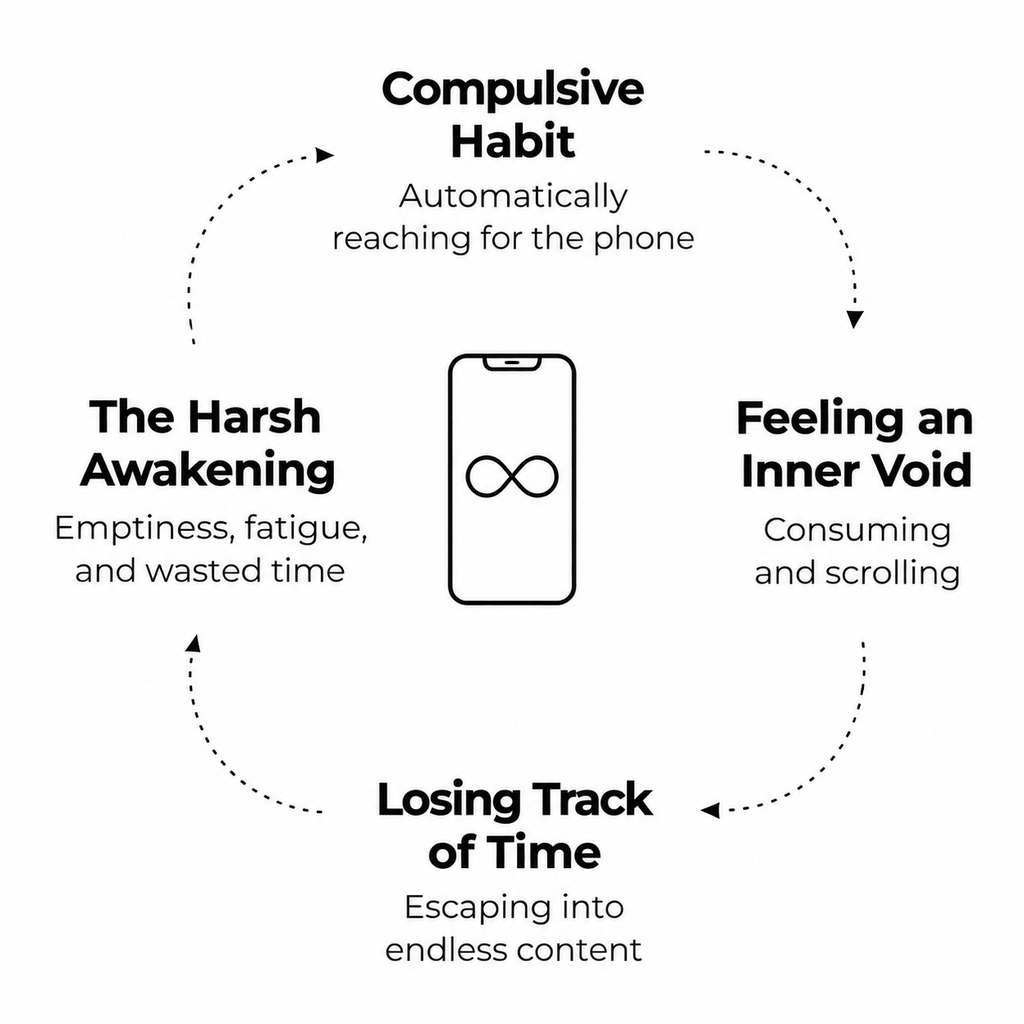
What actually drives that impulse to reach for our phones every spare second? Habit plays a role, certainly. But looking deeper reveals an internal longing—a restless sense that something is missing, that we need something outside ourselves, that we are searching. Yet what most people are truly starved for is connection with their own inner reality: inhabiting the present moment, practicing mindful awareness, and staying grounded in themselves and their surroundings.
Social platforms and smartphones do us a grave disservice by tethering us to systems that alienate us from ourselves and the physical world. While scrolling, our sense of time evaporates. We disconnect from our physical bodies and retreat entirely into an overstimulated mind. The more rapid-fire the inspiration, the more shallow our attention becomes; we skim without depth. The mind never rests. Instead, we deplete our nervous system, leaving us irritable, restless, and frayed.
Furthermore, we surrender our vital creative reserves. The more you consume, the less you create. Most unsettling of all, the algorithmic feed always has something new waiting, because the virtual sphere never pauses. Our physical reality, however, is not designed that way—it unfolds at a far slower, organic pace. After drifting down that rabbit hole and falling into constant comparison, a jarring hangover invariably sets in. You finally look up from your screen and realize how much unrecoverable time slipped away—hours that could have nurtured your life. Anyone who gets caught scrolling knows that heavy, depleted feeling of self-alienation. It takes real effort to re-anchor into everyday reality afterward.
Ironically, the very state we work so hard to avoid is simple, restorative boredom. Standing in a queue is an invitation to just be, to observe the room, to exchange a warm word with a stranger. Commuting offers a chance to look out the window or read. Compulsive scrolling delivers a profound disservice to our nervous system and cognitive focus; it serves no one.
Solitude Deprivation
Can we break free from this cycle? Absolutely. This isn’t about catastrophizing; it is about reclaiming agency so your phone remains a tool rather than a master.
It comes back to the reality that we are unaccustomed to sitting alone with our thoughts and emotions, without immediate stimulation. I deeply appreciate the concept of solitude deprivation, defined by Cal Newport in his book Digital Minimalism: a state in which a person spends virtually zero time alone with their own thoughts, undisturbed by inputs from external minds.
Our nervous system requires stillness to process, digest, and integrate everything unfolding around us. Taking an uninterrupted walk in nature and simply listening to your thoughts is profoundly therapeutic. It allows whatever happened during the day—not just logistical thoughts, but emotional residue—to settle. When we constantly consume and scroll, we dump more stimuli on top of an already full system until there is nowhere left for it to go. That is why chronic solitude deprivation is so corrosive to mental health.
From FOMO to JOMO
Many people consume social feeds out of an underlying dread of missing out. Research consistently highlights this as one of the primary drivers of compulsive screen time: FOMO (fear of missing out).
It is a complete illusion. The moment you step back and disconnect, you quickly realize you aren’t missing anything essential. Quite the opposite: your days begin filling with pursuits that carry genuine meaning and quiet joy. You feel fundamentally better about who you are and how you spend your energy. FOMO dissolves into JOMO—the joy of missing out.
Having spent years active on social networks and years completely off them, I can tell you that JOMO is entirely real. I deeply savor not being on feeds and not consuming them.
How to Begin: A Digital Reset
How do you cultivate this? The most grounded starting point is a structured digital detox—the bridge to becoming a digital minimalist. Start with an intentional container: decide that for fourteen days, or ideally a full month, you will step away from social feeds completely.
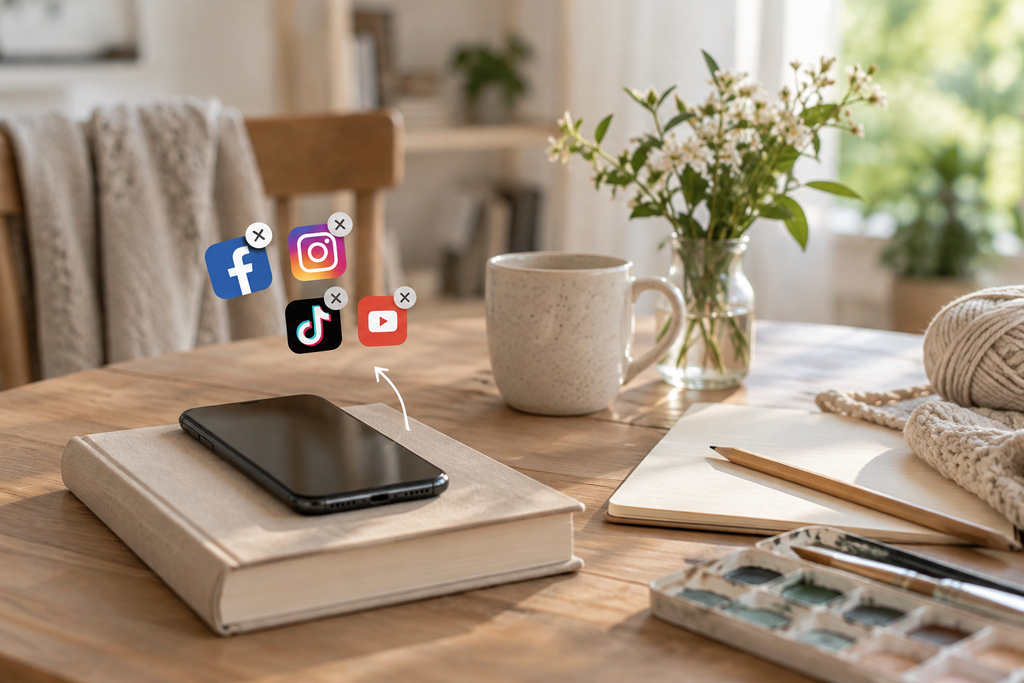
If you take only one practical step from this piece, let it be this: uninstall social media apps from your phone. For over four years, I have had no Facebook, Instagram, or TikTok apps on my mobile device. If I need them, I can log in via an internet browser on my computer for an intentional check-in. It isn’t about disappearing off the face of the earth. But keeping these platforms confined to a computer naturally curbs consumption; we rarely sit at a desk mindlessly scrolling for hours. That structural boundary is transformative.
Crucially, avoid imposing a harsh void without preparation. Before you delete the apps, identify the restorative activities you have been putting off. Many of us carry shelved passions. Working with decluttering clients, I frequently see unused canvases, art supplies, sewing kits, or crochet projects tucked away in closets, waiting for “someday.” It doesn’t need to be highbrow. Tend to small domestic repairs, pot plants in the garden, or go for an aimless walk. Choose practices that restore you and let them naturally replace the impulse to scroll.
It is also revealing to review your built-in screen-time analytics. Look directly at your device settings to see how many hours of your life are spent inside feeds.
Compulsive phone use also creeps in through late-night online shopping or endless binge-watching—playing episode after episode until you wake up exhausted and groggy. That, too, quietly chips away at presence, focus, and self-respect.
Why We Do This
We pursue digital minimalism to regain agency over our lives, feel grounded in our bodies, and tune into our inner world instead of a glowing screen. When we dwell in the present, intuitive insights and emotional clarity surface naturally—guidance far more vital to your life than what someone is staging on an Instagram feed.
We are all wired for this presence. Yet modern hyper-connection severs that natural instinct, conditioning us to believe fulfillment comes from checking off a curated travel destination or buying the next recommended item. Algorithmic networks lock us into a modern form of consumerist servitude, chasing fleeting validations that evaporate in seconds.
Notice how many creators are trapped in a cycle of needing constant attention. Your screen time and focus are their dopamine hit, their fuel, and their prison. I know the operational reality behind the scenes. Staging content while on vacation or outings with children might look effortless and picturesque from the outside, but behind the lens, it is exhausting. You are constantly troubleshooting tech, framing shots, and managing logistics. As a creator, I was rarely fully present with my family during those moments. When I see feeds filled with breathless holiday updates, I don’t feel envious—I feel protective of my own time. I would rather spend those hours unrecorded with my family and friends, anchored in reality.
For me as a writer and guide, unplugging meant embracing the reality that my work might reach a smaller, quieter audience without an algorithmic megaphone. I treat that boundary as a professional commitment. I want to offer deliberate, substantive work rather than adding noise to an already congested digital landscape. There is an ecological footprint to consider as well; running server farms demands vast amounts of electricity. This is a systemic challenge—it goes far beyond sharing an outfit or lunch. So much content feeds off egocentric performance, and passive consumers are the ones keeping that engine running.
I speak candidly, and I acknowledge that. There are undoubtedly thoughtful creators sharing grounded inspiration who manage sustainable boundaries. I honor that balance. Speaking for myself, living with ADHD and high sensitivity makes the chaotic intensity of algorithmic platforms uniquely depleting.
When Feeds Are Most Treacherous
This brings me to another vulnerable reality: mothers caring for young children at home are among the heaviest consumers of social feeds. It is easy to slide into hours of detachment as a coping mechanism—an escape hatch from the relentless physical demands of home life and early parenting. The vibrant digital world feels temporarily easier than managing sticky countertops and sleepless nights. But it can spiral into chronic overwhelm very quickly.
I know this terrain intimately because I lived it, and I see it constantly in consultations with women struggling with heavy procrastination, sensory overload, and exhaustion.
What to Replace Scrolling With
If I could leave you with one foundational rule, it is this: remove social media apps from your phone and restrict access to a desktop browser. Let intentional habits step into the cleared space.
If going for a walk, exercising, gathering with friends, or finishing backlogged creative projects feels like too large a leap initially, start with gentle, focused phone alternatives. Practice a language through an app like Duolingo—it satisfies the tactile habit of tapping and navigating without the toxic comparison trap. Explore visual ideas on Pinterest, keeping in mind that its interface has shifted toward ads and video snippets over time. Immerse yourself in a great book, an audiobook, or long-form podcasts.
I also view YouTube as fundamentally different from short-form feeds. While it can certainly be consumed like junk food through endless shorts, it also houses long-form education, documentaries, and thoughtful tutorials. That is why I maintain a creator presence on YouTube, focusing on long-form, slower formats rather than rapid-fire clips.
What Has Your Experience Been?
I would love to hear your perspective. How does this resonate with you? What boundaries have you established around your smartphone and digital consumption? What practices have supported your peace, and where do you still feel things slipping out of balance? I invite you to share your thoughts in the comments below.
Deepen Your Journey
For a comprehensive guide to simplifying your physical space and clearing emotional baggage, explore the book Healing Tidying™. If you are looking for guided support in your pocket, the Healing Tidying™ app—an intelligent companion drawing directly from my books, essays, and educational frameworks—is available for you to explore. It combines practical decluttering roadmaps and intuitive checklists with gentle psychological support for working through emotional resistance. You can explore your first ten prompts freely to experience how it supports your pace.
Reclaiming Space for What Endures
Unplugging from the digital treadmill gave me the quiet focus required to write my book, develop specialized mentoring frameworks, and establish deep client practices. Had I remained tethered to constant posting, none of this work would exist. More importantly, it preserved our marriage through a period strained by digital distraction and restored authentic connection with our children. The endless pull of social feeds can easily become a black hole, especially for neurodivergent minds navigating ADHD.
Fortunately, there are countless richer ways to live our hours. It is encouraging to see more people speaking openly about the value of stepping away from the noise. I wish you clarity, gentleness, and steady focus as you explore digital minimalism as a way of life.

One Response
Moc děkuji za skvělé tipy, jak omezit scrollování. Cítím se díky nim mnohem klidnější. Uvítala bych ještě více rad, jak zvládnout digitální očistu.