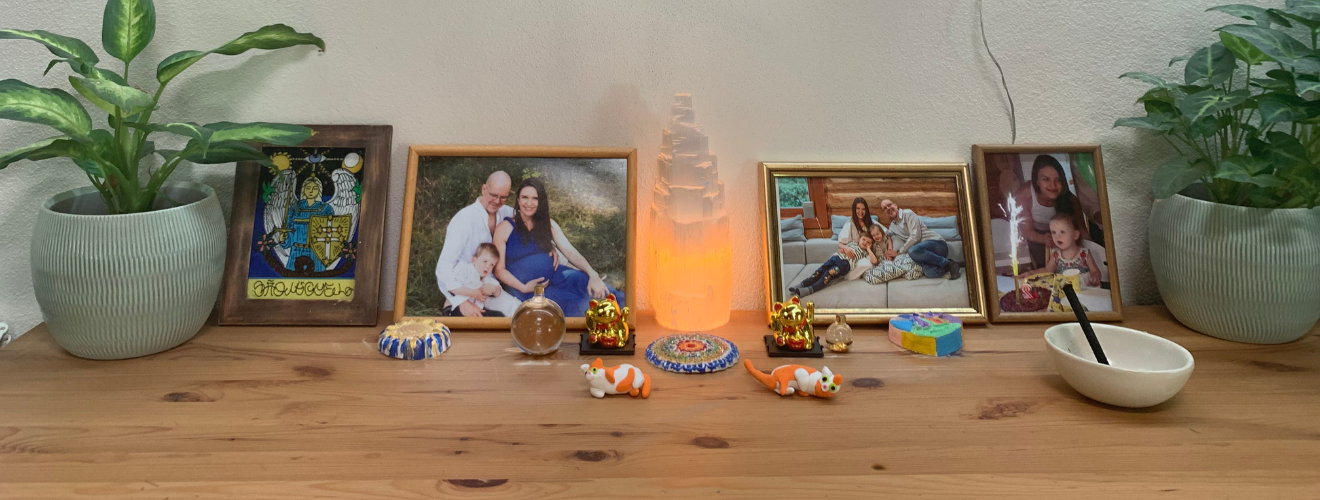
Add a touch of magic to your everyday life with a home altar.
Let’s begin by saying that an altar doesn’t have to exist only in a church. If the word “altar” feels too tied to religious meaning for you, I want to reassure you: it simply refers to a place that holds personal significance and helps you connect with what matters to you. My intention is to inspire you to create such a strong personal energetic space right in your home. How to do it?
Having a home altar doesn’t just mean placing a few objects somewhere and adding a candle. Although that can be meaningful and beautiful — a small display of your favorite items — there is more to it.
What makes an altar an altar is your intention and the ongoing work with it.
When we treat our home as a sacred personal space that supports us on our life journey, conscious work with an altar can greatly enhance that process.
When choosing a place for your altar, consider whether it will be a personal altar for one person or a shared one — for partners, a family, or even a community. For a shared altar, choose a central location. In a home, a great spot is the living room, ideally somewhere with a view of the entrance to the room.
Why create a family or central home altar?
It is a place where you express respect for your home and for what matters to you. An altar can become a place of rest and connection with something greater. It can be where you light a candle when someone close to you needs help, sending support from afar. It can be a place to connect with guides, ancestors, or simply with yourself. When you work with an altar regularly, it becomes a strong energetic point and can even serve as a source of protection for your home.
It depends on what you want to connect with and what you practice. An altar can become a portal into the subtle world or simply a place to connect with yourself and the deeper meaning of life. Even someone very grounded, who doesn’t practice anything they would call spiritual, can use an altar to pause and reconnect with themselves. You can seek answers to life’s questions at your altar. In this case, it’s helpful to connect the altar with intention — your life vision.
In today’s modern, highly individualized society, an altar can become an anchor that provides a sense of safety and rootedness.
Different traditions offer recommendations on what should be placed on an altar and where it should be located. These recommendations often contradict each other. One example is the placement of elements according to cardinal directions — which varies widely across traditions. That’s why I recommend trusting your intuition and creating your altar in a way that feels right to you. Traditionally, the entire altar is placed facing east.
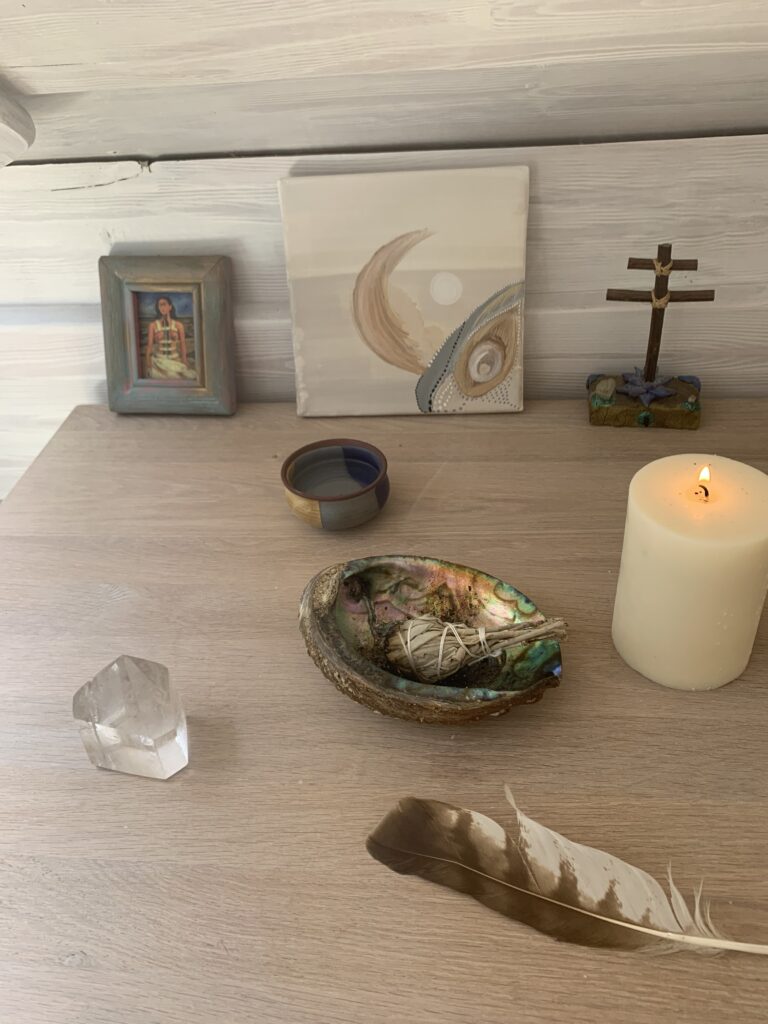
I place representatives of the four elements on my altar — earth, water, air, and fire. Balancing these elements is a core principle we aim for in Healing Clean‑Up and in our home. On my personal altar, I keep a crystal, a shell, a feather, and a white candle. The crystal symbolizes earth, but also simplicity and purity. The shell symbolizes water; a bowl of water works just as well. The feather symbolizes lightness and the element of air, and the candle represents fire. The rest I change according to my mood and the season.
I personally prefer my altar to be light, clean, and not overloaded with objects. And you don’t have to place only photos or statues of ancient masters — you can include modern items that feel meaningful to you. It’s entirely up to you.
What you can place on a personal altar (for inspiration):
- a candle
- personal power objects
- symbols of the four elements
- guides
- sacred symbols
- ritual tools
- crystals
- natural items (stones, shells, wood, etc.)
- flowers
- incense or smudge sticks
- floral water
- statues
I recommend placing items on your altar that are meaningful and hold deep significance for you. Family altars often include photos. Images of joyful moments support a sense of family connection. If you include photos of ancestors, make sure they don’t outnumber photos of living relatives — otherwise the altar may pull you too strongly into the past.
You can adjust your altar seasonally according to the cycle of the year — children can help decorate it. (In the photo on the right, you can see how our children took over decorating our family altar.) In spring and summer, flowers are ideal; in late summer, wheat stalks; in autumn, leaves; and in winter, ivy or pine. Use what naturally surrounds you — it will carry better energy than something grown on the other side of the world. During All Souls’ Day or Samhain, you can place photos of ancestors on the altar and connect with them.
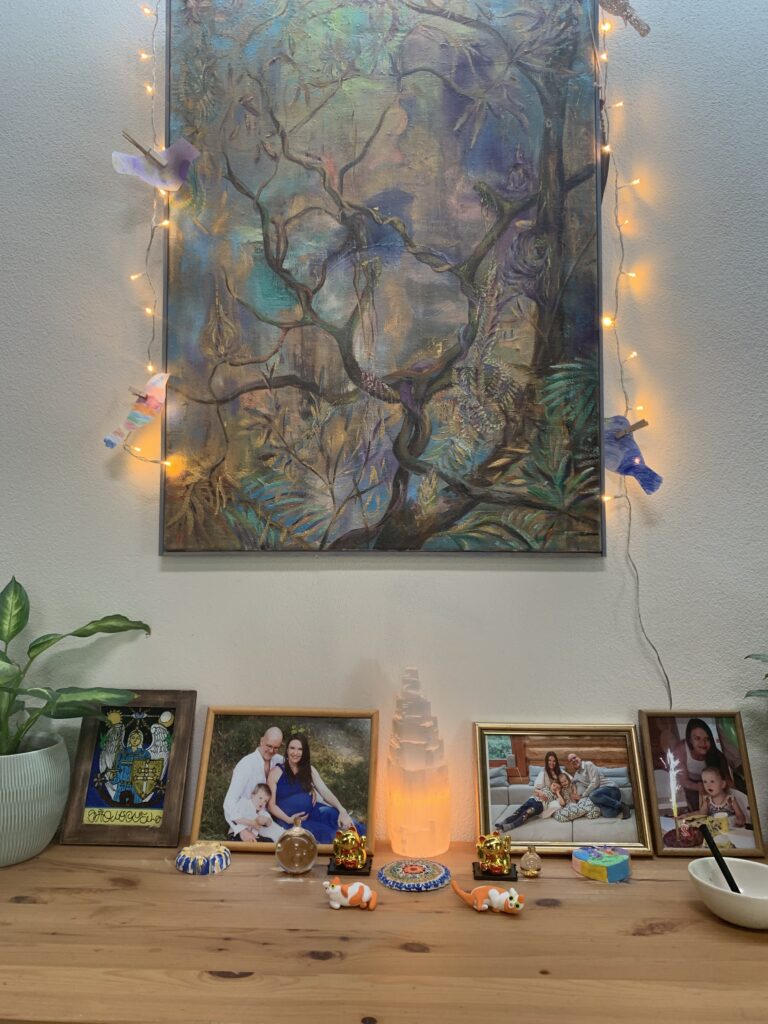
I work with my personal altar regularly
It feels incredibly nourishing to connect with something greater than myself. I regularly express gratitude, seek answers, or ask for guidance. Sometimes I feel the need to perform a deeper personal ritual and connect with what is important in my life — with my life vision. New moons and full moons are ideal for this. During these times, I also place my crystals outside to absorb moonlight (you can simply place them on the outer window ledge).
An altar needs regular care. A dusty, neglected altar won’t feel like a source of healthy life energy or support. When you want to close a difficult chapter of your life, creating a new altar can be part of a ritual of letting go.
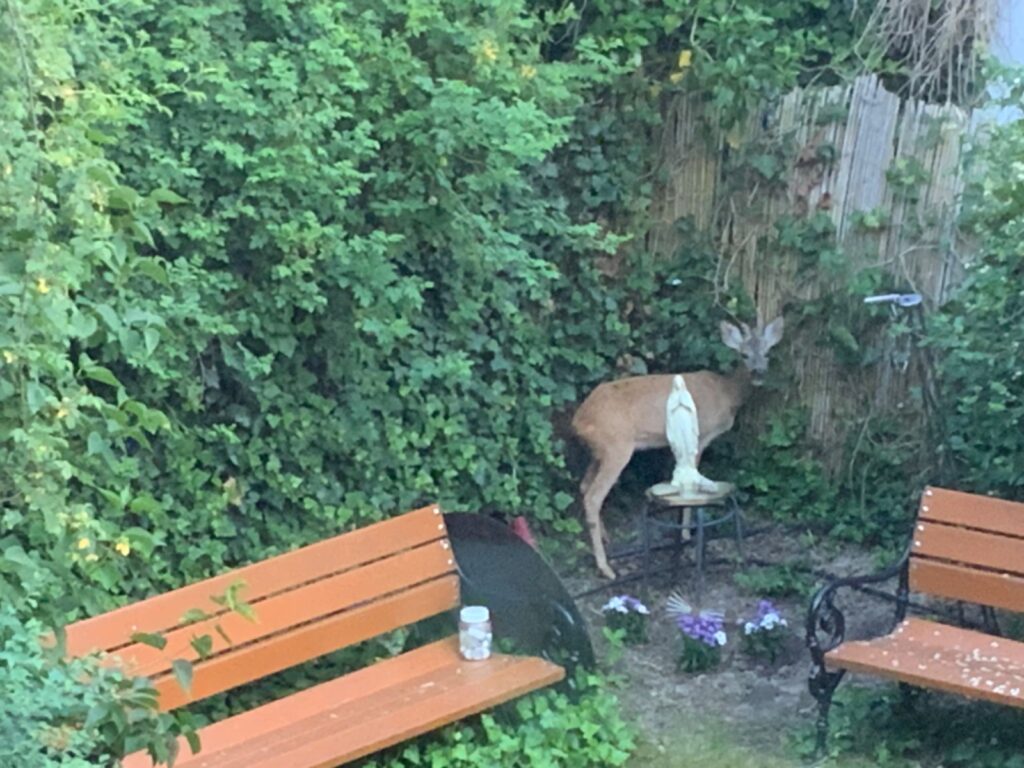
You can also create an altar in your garden. Our garden altar even had a forest visitor — a young deer. We’ve forgiven him for eating all our tomatoes, strawberries, and other vegetables.
An altar should definitely not be a place where you leave everyday items like your phone, keys, or wallet. Be mindful with gifts — they energetically connect you to the person who gave them. I consider items from former partners the least suitable for an altar, even if you currently have a good relationship with them, because they pull you into the past and renew old ties.
An altar can be approached in many ways — everything described above is simply inspiration. And perhaps you don’t feel the need for an altar at all.
To connect with your home from the heart, an altar is not a requirement. But it can be a beautiful way to slow down in our fast modern world, make time for what matters, and give it symbolic physical form.
For some, an altar may feel outdated. I have periods when I work with my altar more, and times when the strongest thing for me is simply walking in the forest and resting at my favorite spots — which I also consider a natural form of “altar.” A home altar is not a condition; it is a pleasant way to honor what matters to us. Why focus only on the practical and rational when life can slip through our fingers? Add magic to your everyday life — you may be surprised how much of it finds its way back to you.
This is a preview from my new book. More inspiration for home rituals and practical steps for effective, gentle, and non‑extreme decluttering can be found in the Healing Clean‑Up book.