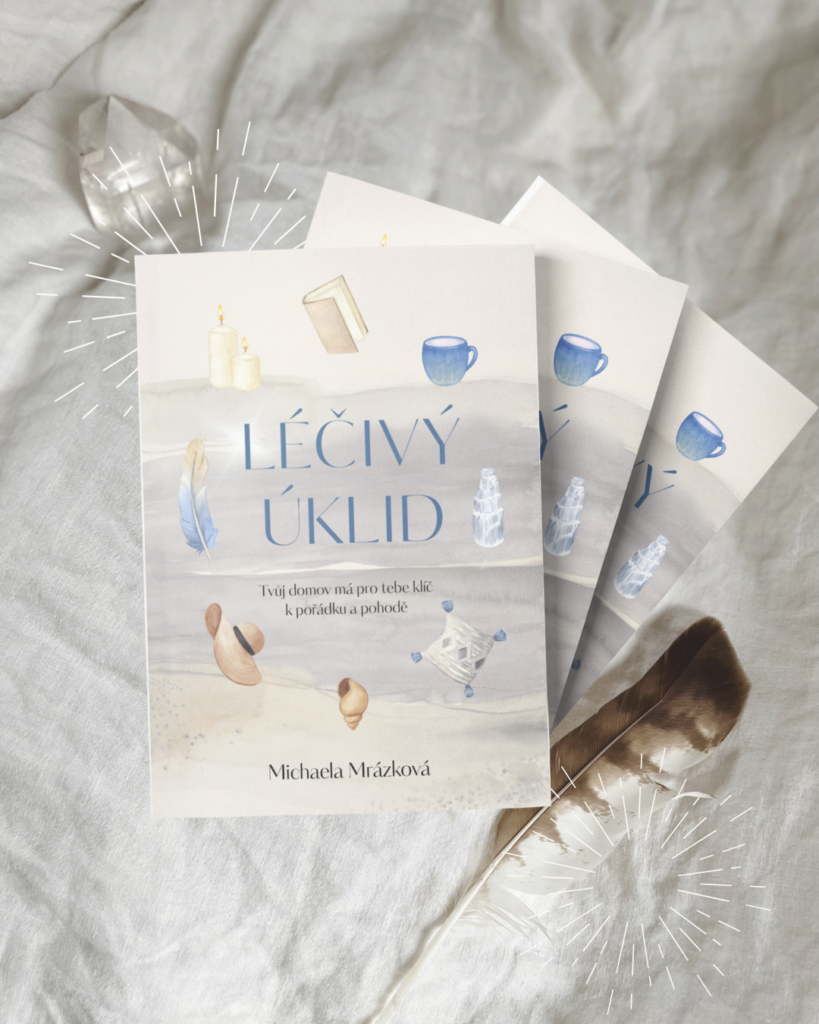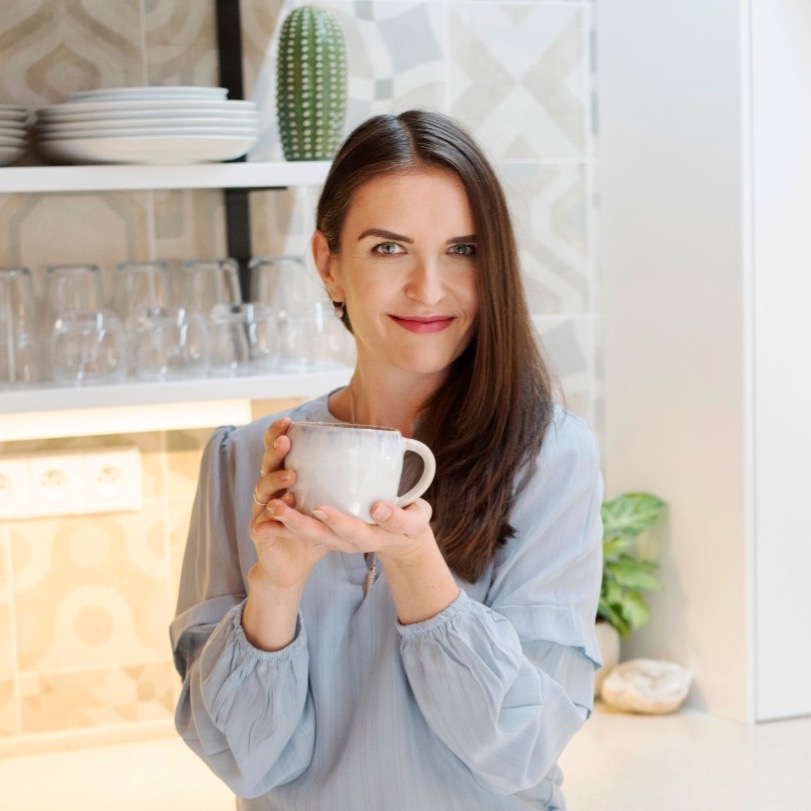
Some time ago, I was invited for an interview in our local Líšnice newsletter, where Dominika Rýparová asked me about the KonMari method, how I discovered it, what my meeting with Marie Kondo was like, and even how my husband perceives the method. You can read the full interview here in this article.
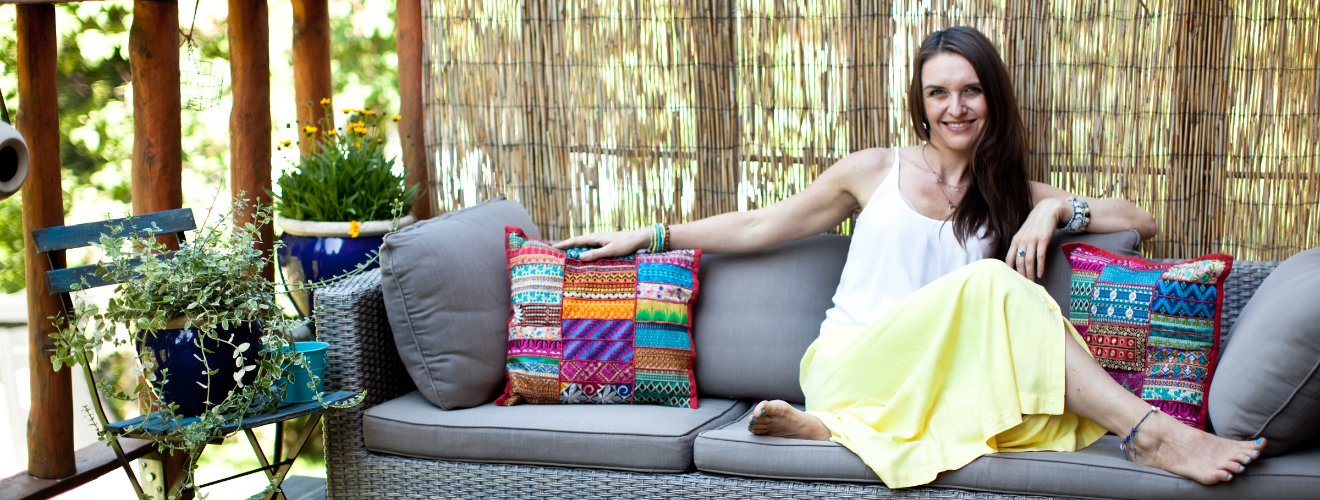
Míša Mrázková, whom you can find online and on social media under the name Více radosti, lives with her husband and children in a distinctive wooden log house in Vandrlice. We talked about constant mess, life with kids, and the art of giving and receiving.
Interview with Dominika Rýparová for Líšnický zpravodaj
I always thought the KonMari method was for people who love systems, who are naturally organized. You say you’re not that type at all, yet this method helped you live more in the moment.
(laughs)
I’d say I’m fairly practical, but I’m not the “Monica from Friends” type. I’m not someone who insists on having everything perfectly aligned, someone who has that system in their DNA. People who choose this work often are like that, and clients usually assume I am too — but I’m not. What fascinates me about the KonMari method is how clear and structured it is, and when we follow it during the decluttering process, it can suit many types of people and households. It truly can help everyone. And because it’s so clearly defined, we don’t have to overthink it — we simply go step by step.
I think that’s great news for many people. I always felt that KonMari would force me to be organized, that I’d lose my freedom, that I’d have to get rid of things I love but don’t necessarily need…
I myself dismissed KonMari years ago, thinking it wasn’t for me (laughs). A friend told me about it, and as soon as she mentioned following a specific order, I thought: nope, not for me. But in the end, I feel that going through this myself — being who I am and solving my own organizational struggles — gives me a better ability to help people who are in the same situation I once was. Because truly organized people probably don’t need help at all — they already have everything “sorted.”
Another thing that scared me was the idea of doing everything at once. But on your website I found a sorting map that allows you to proceed in much smaller steps…
That helps most in families with small children, where it takes a lot of determination to start — you need time, childcare… It makes sense to do it in a big way, to realize how many things you have, to experience that shock. Then it’s easier to choose what to keep and what to let go. But it does require a lot of time. If we follow the basic rule of sorting in the exact order of categories, we can still divide them into subcategories and proceed gradually.
Why is the order so important?
It’s designed so that we start with clothing, because theoretically it’s the easiest to decide about. Then we move through other categories and end with the ones we have the strongest emotional attachment to. The goal is to learn to let go throughout the process. Many people struggle with that. They know they have too much, they want to let go, but they can’t. I think it helps to know that the sorting has a structure — that you start somewhere, move forward, follow a map, and head toward your ideal vision. It simplifies the whole process.
On your Instagram you mentioned the Netflix series Tidying Up with Marie Kondo, where you see overstuffed American homes. Are there cultural differences? How stuffed are Czech homes? Do we differ?
I wouldn’t dare judge it nationally — it’s very individual. But generally speaking, Americans probably have more things overall. Bigger homes, bigger closets, bigger kitchens, bigger fridges. They shop more, have huge discounts and sales — much more than we do. That was visible in the series. But we have people like that here too.
I personally had a similar problem. I shopped a lot in sales, had a lot of clothes — not as much as in the series, but I think in terms of pieces, excluding underwear and socks, we could easily reach a thousand. But most of those things weren’t treasures. I was thrilled about buying cheaply, taking multiple colors of the same item, and it took me a long time to realize it wasn’t advantageous at all — that it’s much better to buy something at full price that I truly love and will use.
KonMari changed my consumer mindset. Many people realize they don’t want to shop fast fashion anymore — they start caring about ecology, materials, production, fair trade. And after investing so much energy into decluttering, they don’t want to clutter their home again with impulse purchases.
What does the certification course look like?
I know it’s online now, and I can’t imagine it much. I took it in person four years ago in London. It was a very intense few days full of lectures and practice, like folding clothes. We also met Marie Kondo herself, which was an intense experience — so I can’t imagine it being online.
What was the biggest benefit of the course? Isn’t reading her books enough?
The biggest benefit was definitely working with clients. You don’t learn that from books — they’re written so anyone can declutter alone. But we learned a lot about how to help others. How to react or proceed when problems arise. And also many organizational tips and tricks.
It reminds me of Marie’s Netflix shows — with the decluttering came huge emotions, relationship improvements, things being said that were never said before. But can a relationship fail because of this process?
I don’t have a specific experience with that. But if partners aren’t aligned, it can be a problem. Decluttering and reorganizing can bring discomfort. From my own experience — when I decided to do this professionally, I tried to apply everything strictly, to test it, to know it works. At one point, I was stricter than Marie Kondo herself. And because I don’t have that system naturally, I tried even harder to follow everything precisely.
And at one point my husband strongly pushed back and said things like: “If Marie Kondo is going to be everywhere here, then it’s either Marie Kondo or me!” (laughs). After that, I eased up a lot. It was an important lesson — now we have it set up so it suits everyone in the household. You can’t force anyone, but you can inspire them. The change you go through is so noticeable that everyone feels it, and I think that’s how they can find their own way to it without pressure.
We women often feel like giving up because “the mess” is made by others. I once read about children’s rooms — that we moms design them how we like, but kids struggle to keep order because they don’t understand where things belong…
In homes with small children, it’s truly hard to maintain order. My kids are small — Toník is four and a half, Anička is one — and I already see we have more mess than when we only had Toník, and it’s getting harder, even though the home is well organized. Even Marie Kondo admitted that with three kids, she sometimes has mess at home. I think the key is having fewer things and creating a system that kids understand — not just the mom who designed it. Everyone should know where things belong. Labeling helps, and older kids can participate — they can label their own things with stickers, pictures, colors. They should understand it’s their room and their responsibility. But it’s a long‑term process.
So the goal of KonMari isn’t to clean once and forever, but to create a system where cleaning isn’t so demanding…
Exactly. The subtitle of the book “The Life‑Changing Magic of Tidying Up — Clean Once and Forever” is misleading. In a sense, it’s true — once you do the big declutter, it should never take that much time again. But it doesn’t mean you’ll never have to clean again. You need to monitor what comes into the home. It’s good to talk to family and ask for consumable gifts or experiences. And if someone doesn’t follow that, look at it through Marie Kondo’s perspective — the act of giving ends with the giving, and if you have no use for the item, you can pass it on. It’s entirely up to you.
These items appear unnoticed, and it’s necessary to go through them occasionally. Especially with kids — they grow, their needs and tastes change. Swap markets are great for that. I like Swap Prague, and there are many similar Facebook groups. For decluttered items, Sue Ryder stores are great — they sell them and use the money for a good cause.
My big problem is old magazines. They pile up, I keep promising myself I’ll read them, I’m afraid I’ll miss something. But I know that when I throw them out, I forget about them and feel relieved…
Marie Kondo even says these things hold you back. When it comes to gifts — keeping something you don’t like just because it feels wrong to throw it away means you’re not fully living for yourself, but trying to meet others’ expectations. What does keeping that gift say about you? What does it symbolize? Books we haven’t read, clothes we’ve never worn, study materials we’ve never opened — according to KonMari, all of that should go. We should be surrounded only by things that mean something to us and that we currently need. She even says that keeping study materials holds us back — it prevents us from practical use or deeper interest because we know we can always read it later, so we postpone it.
When people book a consultation, what do they usually need help with?
It’s very individual. Right now I have clients who struggle with the basics — letting go of unnecessary things. They want me present during the sorting to help them. Another big group are moms with small children who relate to my story and want to improve their home. They often feel overwhelmed — too many things, too much searching, too much chaos — and want to change that.
Do you get to revisit clients later? See how it works for them?
Not always in person. But I care about feedback. I had a client who, when we started, had exactly those closets where everything was just thrown in and fell out when she opened the door. She later found a huge passion for folding clothes, created her own system, improved it, tried different tricks. At the first consultation, I thought she’d laugh at my folding. And I still can’t believe she fell in love with it and still folds today.
Once again, thank you to Dominika for the lovely interview and interesting questions. I hope you learned something new about me.