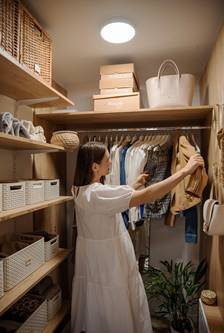

What does a wardrobe look like when it supports you every day – brings lightness and contributes to greater sustainability? About decluttering clothing as a path to clarity, responsibility, and more conscious consumption.
A wardrobe is not just a closet full of clothes. It’s a space that reflects who we are, what our interests and values are. It holds our transformations, past versions of ourselves that we no longer wear but aren’t yet ready to release. It also reflects who we thought we would become – but didn’t. It contains joys and impulsive purchases, gifts we have mixed feelings about, and pieces that once suited us but no longer align with how we feel today.
Decluttering a wardrobe can become a surprisingly powerful tool for reconnecting with yourself and understanding yourself better. It can also spark desired changes in your life. Whether it’s the need for change in a new season or a fresh beginning – for example after a breakup or in connection with a new job.
“Do you want to make a significant change in your life? Clothing is so deeply connected to self‑perception and identity that after decluttering it, you will certainly feel the shift.”
Women I work with are often surprised by how many emotions surface during decluttering. Every piece has its story, and when we look at it closely, it mirrors a part of our past. Many women keep smaller clothes with the hope that one day they’ll fit again. Often, they’re also accompanied by guilt from past impulsive purchases.
Let’s be honest – for many people, decluttering clothing is quite challenging, and they tend to postpone it.
But remember, you don’t need to throw out as much as possible. You only need to keep what represents you and what you truly like. With this awareness, your inner defense mechanisms won’t wake up and whisper, “I can’t let this go, I’ll need it someday.”
And yes, you really can keep everything – but perhaps when you look at an overflowing closet, it’s truly time to let something go…
Decision‑making practice and the vision of an ideal wardrobe
Decluttering clothing is also excellent practice in conscious decision‑making. We learn to distinguish what resonates with us and what no longer does. What is our style, and what we adopted from external ideals or trends. I highly recommend creating a vision of your ideal wardrobe before you begin. It’s very simple – take a pen and paper and answer these questions:
- What are my favorite colors?
- Which materials feel good to me?
- Which cuts flatter me?
- What style do I want to achieve?
This small preparation has enormous power. During decluttering, your vision will help you whenever you feel uncertain.
Questions that help when you’re unsure:
- Do I feel good about this piece?
- Do I wear it?
- Would I buy it again?
- Does it fit my vision?
TIP: Rely on your feelings and only try on pieces you’re unsure about. The goal is to keep the process flowing smoothly without slowing yourself down by endless trying‑on.
The practical side of decluttering
With a change of season comes a natural opportunity to reconsider what no longer serves us and what we want to keep wearing. For some, this can feel like a big task – and that’s okay. Decluttering a wardrobe can be surprisingly demanding – physically and emotionally.
If you don’t have much life energy, divide the process into several phases. One day you can declutter tops, another day a different part of the wardrobe. I want to emphasize that even small decluttering sessions count. If you have small children and very little time, there’s no need to push yourself into big efforts.
However, if a bigger wardrobe clean‑out calls to you and you feel like doing it in one afternoon, that’s possible too – especially if you don’t own an enormous amount of clothing. The reward will be a wonderful feeling of a lighter wardrobe that supports you every day.
Steps for decluttering clothing:
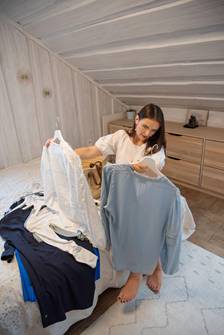
- Bring all items (or a section) from your wardrobe to one place.
- Take each item into your hands and tune into whether you want to keep it.
- Start with items you’re 100% sure you want to let go. Then move to your favorites that you love and want to keep. Only then tackle the uncertain ones.
- Plan ahead where you will take the decluttered items.
- Create three piles:
1. Goodbye
2. Keep
3. Not sure / Maybe
Choose quality
Organize the clothing you keep well. I recommend vertical folding – it’s very clear and practical.
According to the well‑known Pareto principle, we wear only a small portion of our clothing most of the time – roughly 20%. Even in a reduced wardrobe, we often create a group of favorite pieces, while the rest stays aside. We tend to wear tried‑and‑true combinations that bring comfort and certainty.
Some people who love shopping wear only their newest pieces, which they quickly get tired of and leave unused. This approach can resemble relationship instability – constantly seeking new excitement instead of building a relationship with what truly serves us. Long‑term satisfaction comes from a wardrobe built on quality and personal “heart pieces.”
“Become a solid partner to your clothing! Choose quality over quantity and take good care of it.”
Try thinking about different combinations of your favorite pieces. A wardrobe built on high‑quality basics is timeless. When you build your wardrobe as a long‑term project, you won’t find yourself standing in front of an overflowing closet again anytime soon.
TIP: Create a shopping list of basic pieces, keep it handy, and stick to it when shopping.
Allow yourself to choose quality as an expression of respect for yourself. Why settle for low‑quality clothing bought on sale and produced under unethical conditions? The issue of fast fashion’s unsustainable approach is a very current topic, and it begins in each of our closets. Personally, I choose a combination of second‑hand shopping and slow fashion brands.
TIP: Open yourself to second‑hand shopping. When buying clothing online (e.g., on Vinted), set detailed filters including color, size, brand, material, and a price that filters out very cheap, low‑quality items. You’ll save lots of time. Voilà – one of the simplest ways to shop.
I wish you lightness and clarity as you declutter and build a wardrobe you feel good in.
If the topic resonates with you deeply, take a look at the Healing Clean‑Up book.