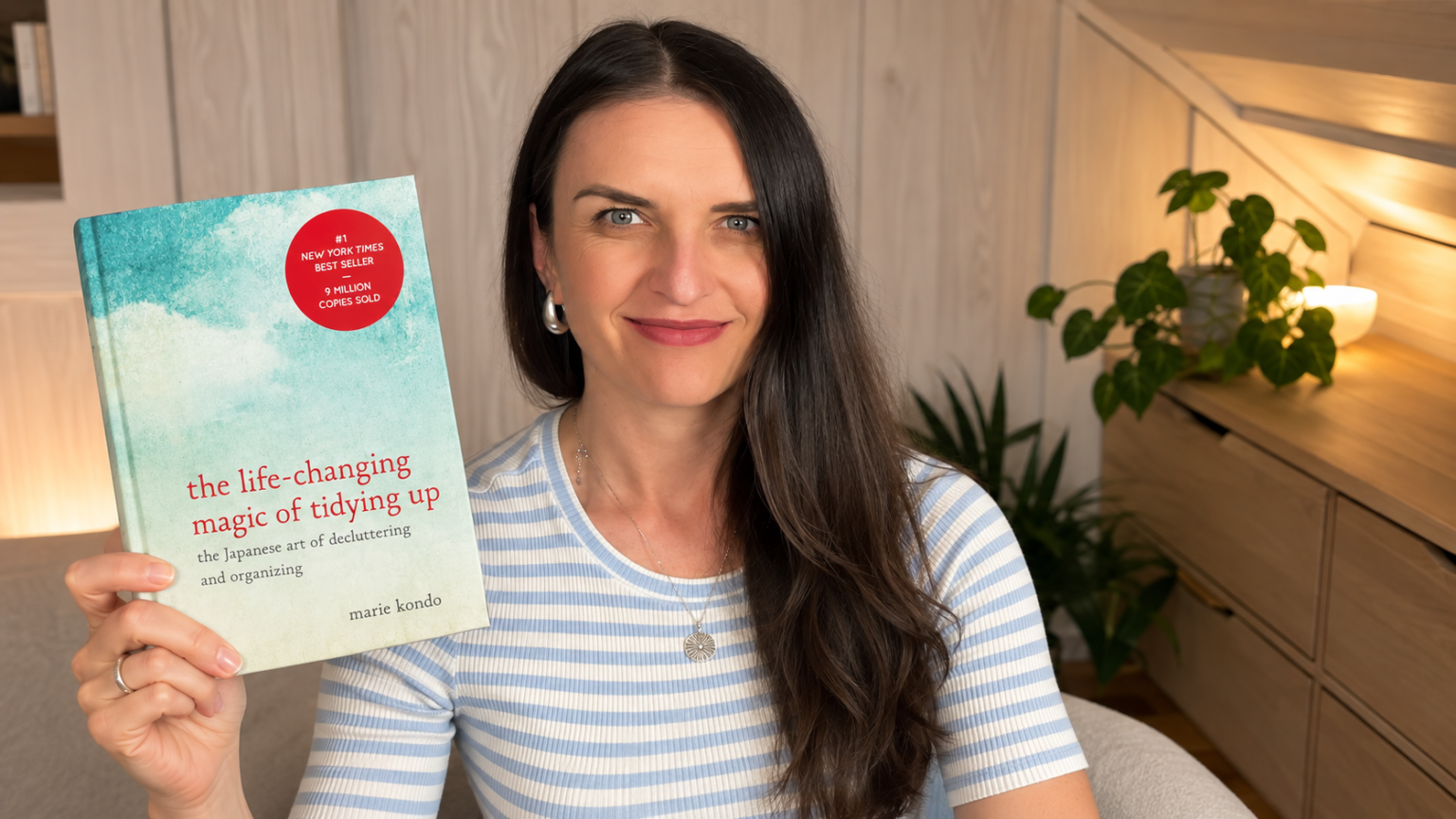
Do you feel that lightening your home requires extreme measures? That you have to drag everything out into a massive pile on the floor, start strictly with clothes, and march through a rigid, uncompromising checklist? If that sounds familiar, you’ve likely encountered the KonMari Method®—the famous Japanese approach created by Marie Kondo.
I’ll openly admit right from the start: I spent years practicing the KonMari Method® deeply, both in my own home and alongside my clients. And precisely because I walked this path for so long, I can share with complete honesty where it gradually stopped working for me—and why it often fails real-life households.

Intensive Decluttering: Beautiful in Theory, Challenging in Practice
The core pillar of the KonMari Method® is tackling clutter intensively, all in one go. You gather every item from a single category into one enormous heap and sort through the whole lot in a marathon session.
From the standpoint of shock value and visual clarity, it certainly works. You see the sheer volume of your possessions in plain sight. But this is also the exact moment when most people hit a wall and give up.
When someone’s home is in chaos, it is tempting to chase a silver bullet—a sweeping, cinematic transformation that will fix everything by Sunday night. Yet here lies the paradox: the more radical and perfectionist the solution, the easier it is to procrastinate. A massive leap demands a massive amount of energy, and very few people have the stamina to spend an entire weekend drowning in heaps of clothes.
Who struggles most with this all-or-nothing approach? Anyone running on empty. A mother juggling toddlers. A tired retiree. Anyone who simply doesn’t have the emotional or physical bandwidth to handle overwhelming piles.
Does that mean they shouldn’t bother decluttering? Absolutely not. All-at-once marathons are far from the only path forward.
Small Steps: A Kinder, Sustainable Way
The gentler alternative is taking small, intentional steps. You start where you can. It might not look like a picture-perfect Japanese ritual wrapped up in a weekend, but it will be sustainable—and it will be truly yours.
You don’t have to empty your entire wardrobe. You can choose just one small section. Pick a single drawer. Sort through your T-shirts. Make a little progress, celebrate the win, and stop for the day. For anyone carrying guilt after putting off decluttering for months, this gentle pace is the most effective way to finally build momentum.
This isn’t an either/or choice. Small habits and bigger sorting days support each other beautifully. When your energy is high, dive into a larger project; when you feel depleted, slow down. Tidying shouldn’t be a rigid dogma.
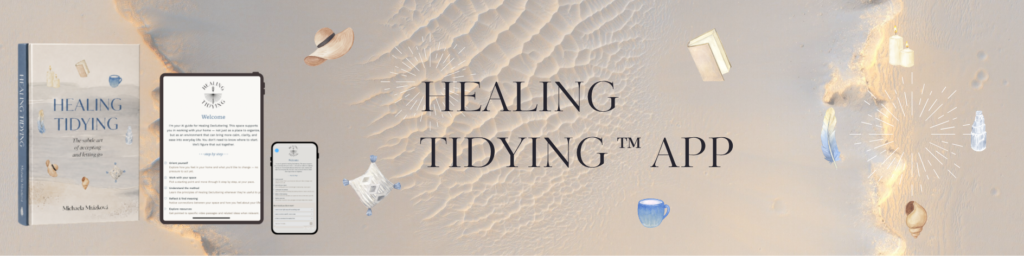
There is no need for universal guides. Try the Healing Tidying™ App for free; it adapts to your personal needs, as each of us is different. Discover it here.
Strict Category Order: Why It Stopped Making Sense to Me
Marie Kondo recommends sorting in a precise order of categories: clothing, books, papers, komono (a Japanese term for miscellaneous items from electronics to office supplies), and finally sentimental items.
Saving emotionally heavy heirlooms for last makes complete sense. But does every household under the sun need to follow that exact sequence? That’s where the system breaks down for me.
I’ve supported many women who refused to start with clothing because they were struggling with body image, weight changes, or emotional baggage tied to their closet. Forcing a client to start where she feels most vulnerable is the last thing I would ever do.
I remember a client—let’s call her Bea. When I arrived, she shared that another consultant had worked with her previously. Bea had desperately wanted to start with the kids’ playroom, which was causing daily friction in her family. But she was told that breaking the sequence wasn’t permitted—the KonMari Method® must begin with clothes. So they spent that day sorting dresses instead of solving the burning issue in her home.
That experience stayed with me. I firmly believe in starting wherever you feel called to begin—wherever your natural momentum lies. You know your home best. Universal formulas simply don’t work for unique lives.
A Question of Cultural Context
Context matters. Marie Kondo published her original Japanese book in 2010 (with the English translation arriving two years later), sparking a global revolution in conscious living.
Over a decade later, our understanding of personal growth and organizing has evolved significantly. We no longer need rigid, dogmatic frameworks. Personal development has moved toward honoring the individual.
There is also a profound cultural difference. Japanese homes are traditionally compact and contain significantly fewer belongings—making it realistic to complete the entire process in just one or two weekends. While researching my book, a Japanologist confirmed how deeply structured, step-by-step frameworks are embedded in Japanese culture. But hand on heart: how many of us thrive under rigid rules without wanting to adapt them to our own lifestyle? Understanding this cultural gap explains why forcing a strict Japanese framework onto a busy European household often causes friction.
What I Still Cherish About the KonMari Philosophy
This isn’t about discarding the method entirely. There are brilliant elements within the KonMari Method® that I continue to use daily.
Vertical folding and upright storage remain game-changers for visibility and order. And I deeply respect Marie’s core premise: choosing what to keep based on what aligns with you, rather than obsessing over what to throw away.
Where I offer an adjustment is the concept of “Joy.” For many, Spark Joy can feel overly dramatic, almost euphoric—as if a pair of socks or a can opener must trigger overwhelming excitement. When everyday items fail to deliver that emotional high, people freeze.
A much kinder, grounded question is: “Does this item give me a good feeling?” Practical ease and daily usefulness create genuine peace. Starting with items you know you are ready to let go of builds confidence quickly. Releasing the pressure to reach a minimalist ideal is where real healing begins.
Life Evolves—and So Has Marie Kondo
You might have seen the headlines in recent years: In 2023, Marie Kondo openly shared that her home is far from immaculate right now, choosing instead to focus her energy on her three young children. The media sensationalized this as her “giving up on tidying,” but the real takeaway is much deeper. As a mother of three, she has embraced real life over rigid perfectionism. Her reality today looks nothing like when she wrote her first book as a young woman living alone in a small Tokyo apartment.
I feel a bit sad that she hasn’t yet expanded her book to include an edition tailored for households with small children. But that’s the exact gap I address in my own book, Healing Tidying™—where the approach isn’t built on perfection at all.
The Path Forward
Taking small, steady steps might not deliver an overnight makeover. It takes time. But when your decluttering honors your energy, your current season of life, and your true needs, the transformation lasts. You finish what you started without burning out along the way.
And for me, that’s the most important thing.
Have you ever tried the KonMari Method®? Did you complete the entire journey, or did you find yourself stuck somewhere along the way? Share your experience in the comments!